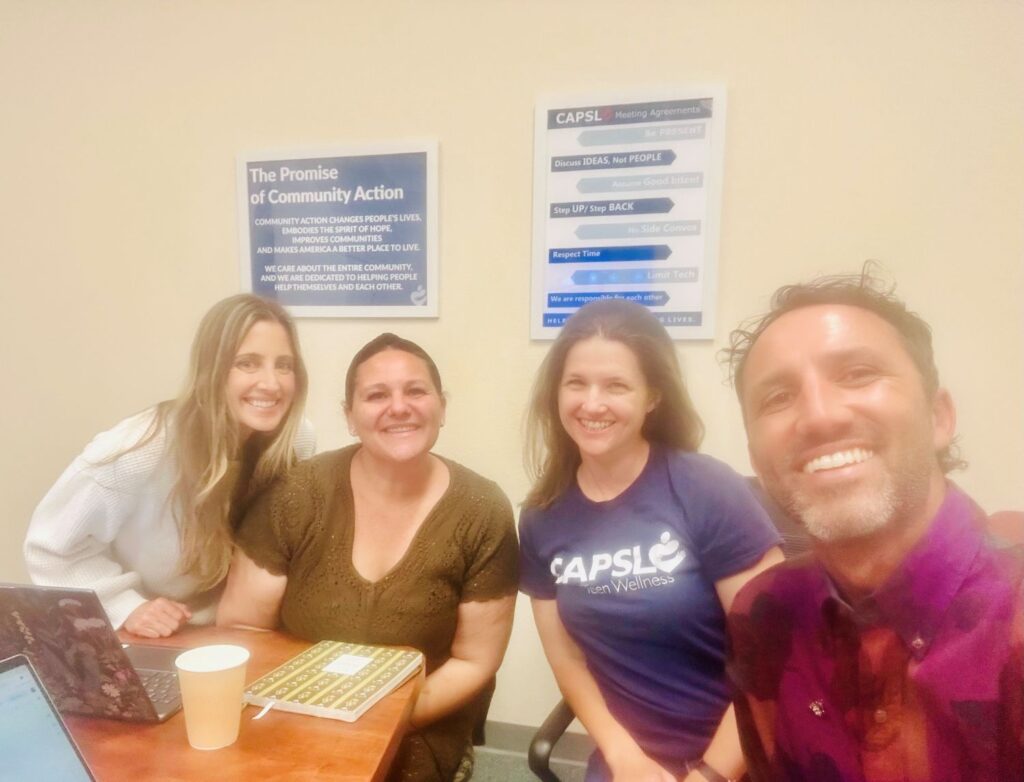
Jennifer Khalifa, the Partnership’s Senior Director of Prevention and Capacity Building, visits the Prevention Team at Community Action Partnership of San Luis Obispo County.
Domestic violence doesn’t have to be a part of the human experience. It is possible to prevent abusive relationships in the first place when we organize toward a common goal: ensuring that everyone has access to the resources they need to thrive.
Preventing domestic violence is core to our organization’s work. Our comprehensive approach is grounded in a public health framework—from individual-level education with people of all ages, to addressing inequality as a root cause of domestic violence. We use proven prevention strategies to support the community conditions that promote healthy relationships, including working with local domestic violence organizations as they implement parent support programs to build community connection. At the same time, we change the harmful social norms that perpetuate violence, including supporting local projects that challenge traditional gender roles.
Here’s what we’re doing to prevent domestic violence in California:
Developing a Statewide Plan to Prevent Domestic Violence in California
The Partnership is one of thirteen state domestic violence coalitions selected by the CDC to participate in their program, Domestic Violence Prevention Enhancement and Leadership Through Alliances: Achieving Health Equity through Addressing Disparities. We work with leaders from across the state to implement a prevention state action plan rooted in ensuring that Californians have the social supports they need to be safe. Our plan will include efforts to promote economic justice as a violence prevention strategy—for example, working with a broad coalition to expand the state’s family leave policies. When families experience less financial stress, the likelihood of abuse decreases.
Creating Spaces for Preventionists to Connect
Doing prevention work can feel isolating and uncertain—especially with shoestring budgets and less public knowledge of these strategies. In collaboration with ValorUS, Prevention Team staff strive to provide preventionists with a sense of community. We create monthly spaces for peer learning for prevention supervisors and school-based prevention educators. We also disseminate up-to-date prevention resources through a monthly Prevention Peer Network newsletter and listserv, and bi-monthly webinars.
Training Programs on How to Prevent Domestic Violence
Domestic violence is inextricably connected with other forms of violence, discrimination and oppression. One of our hallmark activities, the Building Change Together (BCT) training, explores how preventionists can create more equitable communities where domestic violence is less likely to occur.
Every year, we introduce participants to the Primary Prevention Core Competencies. Developed collaboratively by the California Department of Public Health, the Partnership and ValorUS, the Core Competencies define the basic and essential frameworks, attitudes, characteristics, skills, and behaviors that are widely considered to be necessary to develop, implement, evaluate, and sustain domestic violence primary prevention initiatives.
Most recently offered in June, this interactive 3-day training offered participants the opportunity to strengthen their knowledge, skills, and competencies to effectively implement domestic violence prevention efforts in their communities. Preventionists learned how to apply the Social Ecological Model to identify risk and protective factors, understand the root causes of violence, and develop community-based prevention strategies that create change at the individual, relationship, community, and societal levels.
Participants walked away with skills in prevention planning, community engagement, coalition building, and evaluation, while developing practical tools and strategies that can be applied in their local prevention efforts. Through skill-building activities, case studies, reflection exercises, small-group discussions, and peer learning, this year’s BCT inspired participants to think more broadly about their prevention programs, continue to build connections with their fellow preventionists, and implement new prevention strategies in their communities.
What’s Coming Up
Through our prevention work, we’re helping communities create the conditions where healthy relationships are the norm and all people can thrive. Here’s a sneak peak of what we’re working on in 2026:
- Hosting prevention workshops at our Statewide Domestic Violence. Register today!
- Engaging a Youth Advisory Committee to lead our statewide Teen Dating Violence Awareness and Prevention Month campaign in February, with a focus on the prevention of AI-assisted abuse
- Holding focus groups to dive deeper into prevention strengths and gaps identified in our 2025 State Needs Assessment
Get in Touch
Without prevention, there’s no path to ending domestic violence; but together with preventionists across California, the Partnership has built a shared vision and identified the strategies to make it a reality. What prevention strategies are most needed in your community? Drop us a note at info@cpedv.org. We’d love to hear from you. Together, we can build a California free from domestic violence.
Uncategorized