By Timothy S. Ruise
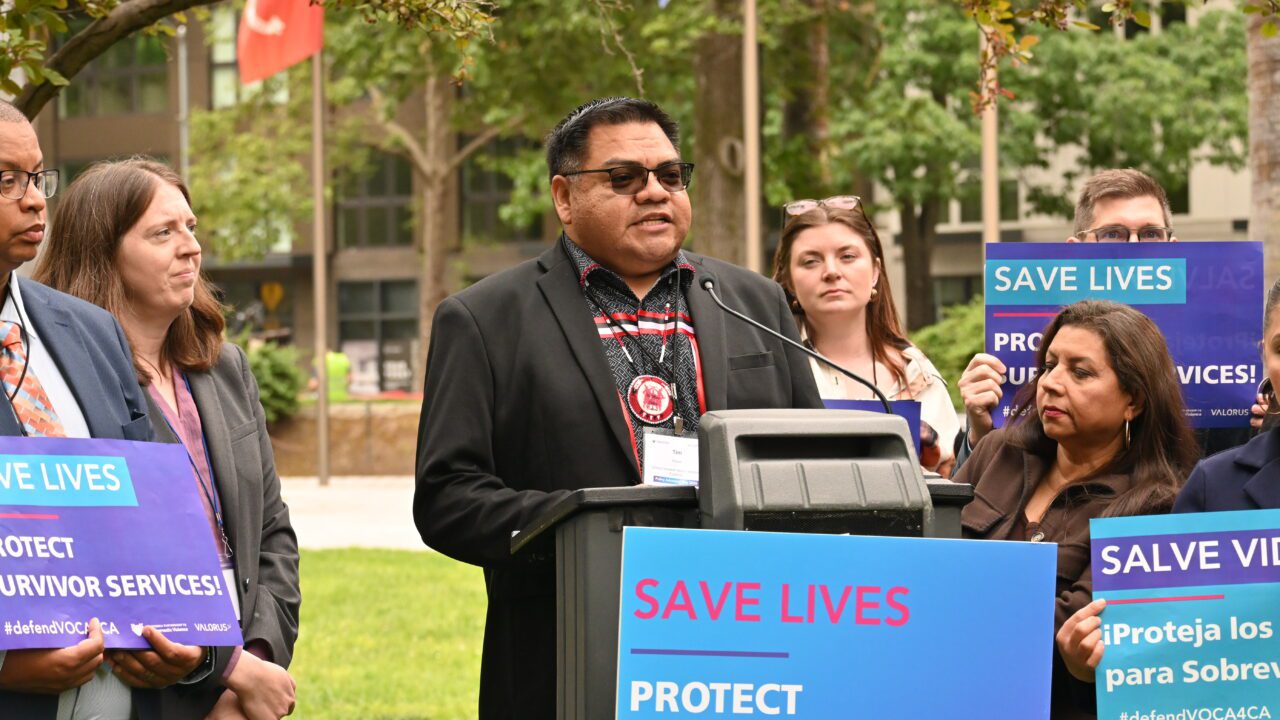
On May 5, as buildings across California glowed red for Missing and Murdered Indigenous Peoples (MMIP) Awareness Day, I stood on the steps of our State Capitol—not just as an advocate, but as a survivor. I carried the names of those we’ve lost, the weight of families still searching, and my own story—of surviving violence, coping through addiction, and navigating systems that too often fail our people.
MMIP is not just a day of recognition for Native communities—it is an ongoing crisis. If California is serious about protecting survivors and addressing violence, legislators must act. That means committing $100 million in Victims of Crime Act (VOCA) funding in the state budget to ensure survivors—especially those in Tribal and underserved communities—have access to life-saving services.
I am Cahuilla, Aha Macav of Ft. Mojave, Iipay, and Payōmkawichum, and a member of the Two-Spirit and LGBTQ+ community. I grew up on the reservation facing poverty, violence, and instability. Like many survivors, I turned to alcohol and drugs to cope because I did not have access to the support I needed. There were no consistent safe spaces, and systems meant to protect children did not always listen or protect.
Healing began when I found culturally grounded, community-based support—spaces that saw me as more than my trauma and understood my identity, culture, and lived experience. That kind of care is not a luxury; it is essential.
Today, as the Community Outreach Coordinator with Strong Hearted Native Women’s Coalition, I work directly with survivors of domestic violence, sexual assault, trafficking, and families impacted by MMIP. Many come to us after falling through every crack—turned away, misunderstood, or left without services simply because of where they live.
The need is urgent. Native Americans experience some of the highest rates of violence in the country. Native women face violence at rates two to three times the national average, with more than 4 in 5 experiencing violence in their lifetime, (National Institute of Justice, 2016; Bureau of Justice Statistics, 2017). Native men and boys are also deeply impacted—more than 4 in 5 will experience violence in their lifetime (National Institute of Justice, 2016). Many MMIP, DV, and SA cases remain unreported or under-investigated due to jurisdictional gaps, little to no law Enforcement training of Tribal Governments and lack of coordinated response.
For Tribal communities, these gaps are even more pronounced. Survivors and families are often left navigating complex systems alone, without clear pathways to support or culturally competent services.
Our work is supported through federal VOCA funding, but VOCA reserves are too low to meet the demand. Across California, victim service programs are being stretched thin—cutting staff, reducing services, or closing entirely. Tribal and culturally specific organizations face the greatest barriers.
Some may argue that California cannot afford a $100 million investment in victim services. The reality is we cannot afford not to. When survivors do not receive support, the costs shift to emergency rooms, law enforcement systems, foster care, and lives lost.
MMIP Awareness Day must be more than symbolic—it must lead to action. California has an opportunity and a responsibility to ensure that survivors are not left behind. Investing in VOCA is about saving lives, strengthening communities, and delivering on the promise of justice.
Survivors deserve to be believed. Families deserve answers. Communities deserve resources. Now is the time for Governor Newsom and California’s leaders to act.
Timothy S. Ruise is the Community Outreach Coordinator for Strong Hearted Native Women’s Coalition and a victim services advocate serving Tribal communities across Southern California.
Uncategorized